



历史上的今天
今天是:2024年11月01日(星期五)
2021年11月01日 | 宽带数据转换器应用的JESD204B与串行LVDS接口考量
2021-11-01 来源:EEWORLD
JESD204B vs. Serial LVDS Interface Considerations for Wideband Data Converter Applications
宽带数据转换器应用的JESD204B与串行LVDS接口考量
Abstract
摘要
The JESD204A/JESD204B industry standard for serial interfaces was developed to address the problem of interconnecting the newest wideband data converters with other system ICs in an efficient and cost saving manner. The motivation was to standardize an interface that would reduce the number of digital inputs/outputs between data converters and other devices, such as field programmable gate arrays (FGPAs) and system on a chip (SoC) devices through the use of a scalable high speed serial interface.
开发串行接口业界标准JESD204A/JESD204B的目的在于解决以高效省钱的方式互连最新宽带数据转换器与其他系统IC的问题。其动机在于通过采用可调整高速串行接口,对接口进行标准化,降低数据转换器与其他器件(如现场可编程门阵列FPGA和系统级芯片SoC)之间的数字输入/输出数量。
Trends show that new applications, as well as advances in existing ones, are driving the need for wideband data converters with increasingly higher sampling frequencies and data resolutions. Transmitting data to and from these wideband converters poses a significant design problem as bandwidth limitations of existing I/O technologies force the need for higher pin counts on converter products. Consequently, systems’ PCB designs have become increasingly more complex in terms of interconnect density. The challenge is routing a large number of high speed digital signals while managing electrical noise. The ability to offer wideband data converters with GSPS sampling frequencies, using fewer interconnects, simplifies the PCB layout challenges, and allows for smaller form factor realization without impacting overall system performance.
趋势显示最新应用,以及现有应用的升级,正不断需求采样频率和数据分辨率更高的宽带数据转换器。向这些宽带转换器传送和获取数据暴露了一个非常大的设计问题,即现有I/O技术带宽的限制导致转换器产品需要使用的引脚数更多。其结果便是PCB设计随着互连密度的增加而更复杂。其挑战在于进行大量高速数据信号走线的同时控制电噪声,以及提供GSPS级别的宽带数据转换器采样频率的能力、使用更少的互连、简化PCB布局难题并实现更小的尺寸,且不降低整体系统性能。
Market forces continue to press for more features, functionality, and performance in a given system, driving the need for higher data-handling capacity. The high speed analog-to-digital converter and digital-to-analog converter-to-FPGA interface had become a limiting factor in the ability of some system OEMs to meet their next generation data-intensive demands. The JESD204B serial interface specification was specifically created to help solve this problem by addressing this critical data link. Figure 1 shows typical high speed converter-to-FPGA interconnect configurations using JESD204A/JESD204B.
市场力量继续施压,要求给定系统拥有更多特性和功能以及更好的性能,推动了对更高数据处理能力的要求。高速模数转换器和数模转换器至FPGA接口已成为某些系统OEM厂商满足下一代大量数据处理需要的限制因素。JESD204B串行接口规范专为解决这一关键数据链路的问题而建立。图1显示使用JESD204A/JESD204B的典型高速转换器至FPGA互连配置。
Some key end-system applications that are driving the deployment of this specification, as well as a contrast between serial low voltage differential signaling (LVDS) and JESD204B, are the subject of the remainder of the article.
本文余下篇幅将探讨推动该规范发展的某些关键的终端系统应用,以及串行低压差分信号(LVDS)和JESD204B的对比。
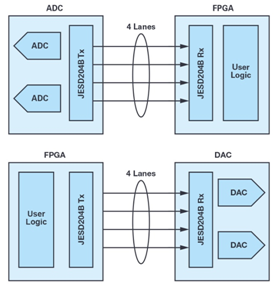
Figure 1. Typical high speed converter to FGPA interconnect configurations using JESD204A/JESD204B interfacing (Source: Xilinx®).
图1.使用JESD204A/JESD204B接口的典型高速转换器至FGPA互连配置(来源:Xilinx®)。
The Applications Driving the Need for JESD204B
应用推动对JESD204B的需求
Wireless Infrastructure Transceivers
无线基础设施收发器
OFDM-based technologies, such as LTE, used in today’s wireless infrastructure transceivers use DSP blocks implemented on FPGAs or SoC devices driving antenna array elements to generate beams for each individual sub- scriber’s handset. Each array element can require movement of hundreds of megabytes of data per second between FPGAs and data converters in both transmit or receive modes.
目前无线基础设施收发器采用LTE等基于OFDM的技术,这类技术使用部署FPGA或SoC器件的DSP模块,通过驱动天线阵列元件,单独为每个用户的手机产生波束。在发射和接收模式下,每个阵列元件每秒可能需要在FPGA和数据转换器之间传输数百兆字节的数据。
Software-Defined Radios
软件定义无线电
Today’s software-defined radios utilize advanced modulation schemes that can be reconfigured on the fly, and rapidly increasing channel bandwidths, to deliver unprecedented wireless data rates. Efficient, low power, low pin count FPGA-to-data converter interfaces in the antenna path play a critical role in their performance. Software-defined radio architectures are integral to the transceiver infrastructure for multicarrier, multimode wireless networks supporting GSM, EDGE, W-CDMA, LTE, CDMA2000, WiMAX, and TD-SCDMA.
当今的软件定义无线电技术利用先进的调制方案,可即时重配置,并极大地增加了通道带宽,提供最佳的无线数据速率。天线路径中高效、低功耗、低引脚数的FPGA至数据转换器接口对性能起着决定性的作用。软件定义无线电架构已与收发器基础设施相整合,用于多载波、多模无线网络,支持GSM、EDGE、W-CDMA、LTE、CDMA2000、WiMAX和TD-SCDMA。
Medical Imaging Systems
医疗成像系统
Medical imaging systems including ultrasound, computational tomography (CT) scanners, magnetic resonance imaging (MRI), and others generate many channels of data that flow through a data converter to FPGAs or DSPs. Continually increasing I/O counts are driving up the number of components by requiring the use of interposers to match FPGA and converter pin out and increasing PCB complexity. This adds additional cost and complexity to the customer’s system that can be solved by the more efficient JESD204B interface.
医疗成像系统包括超声、计算机断层扫描(CT)的扫描仪、磁共振成像(MRI)等,这些应用产生很多通道的数据,流经数据转换器至FPGA或DSP。I/O通道数的持续增长要求使用内插器匹配FPGA和转换器的引脚输出,迫使元件数增加,并使PCB复杂化。这加大了客户系统的成本支出以及复杂程度;而这些问题可通过采用更有效的JESD204B接口加以解决。
Radar and Secure Communications
雷达和安全通信
Increasingly sophisticated pulse structures on today’s advanced radar receivers are pushing signal bandwidths toward 1 GHz and higher. Latest generation active electronically scaled array (AESA) radar systems may have thousands of elements. High bandwidth SERDES-based serial inter- faces are needed to connect the array element data converters to the FPGAs or DSPs that process incoming and generate outgoing data streams.
目前先进雷达接收器的脉冲结构日益复杂,迫使信号带宽上升至1 GHz或更高。最新的有源电子调整阵列(AESA)雷达系统可能包含上千个元件。高带宽SERDES串行接口用于连接阵列元件数据转换器与FPGA或DSP,处理接收到的数据流,并将处理后产生的数据流发送出去。
Serial LVDS vs. JESD204B
串行LVDS与JESD204B的对比
Choosing Between Series LVDS and JESD204B Interface
在串行LVDS和JESD204B接口之间选择
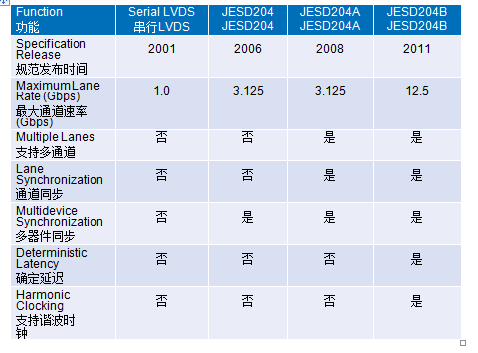
In order to best select between converter products that use either LVDS or the various versions of the JESD204 serial interface specification, a comparison of the features and capabilities of each interface is useful. A short tabular comparison is provided in Table 1. At the SERDES level, a notable difference between LVDS and JESD204 is the lane data rate, with JESD204 supporting greater than three times the serial link speed per lane when compared with LVDS. When comparing the high level features like multidevice synchronization, deterministic latency, and harmonic clocking, JESD204B is the only interface that provides this functionality. Systems requiring wide bandwidth multichannel converters that are sensitive to deterministic latency across all lanes and channels won’t be able to effectively use LVDS or parallel CMOS.
为了在使用LVDS和多种版本JESD204串行接口规范的转换器产品间做出最佳选择,对每种接口的特性和功能进行比较会非常有用。表1以简单的表格形式对接口标准进行了对比。在SERDES级,LVDS和JESD204之间的显著区别是通道数据速率,JESD204支持的每通道串行链路速率是LVDS的三倍以上。当比较诸如多器件同步、确定延迟和谐波时钟等高级功能时,JESD204B是提供这些功能的唯一接口。所有通路和通道对确定延迟敏感、需要宽带宽多通道转换器的系统将无法有效使用LVDS或并行CMOS。
Table 1. Comparison Between Serial LVDS and JESD204 Specifications
表1.串行LVDS和JESD204规范对比
LVDS Overview
LVDS概述
LVDS is the traditional method of interfacing data converters with FPGAs or DSPs. LVDS was introduced in 1994 with the goal of providing higher bandwidth and lower power dissipation than the existing RS-422 and RS-485 differential transmission standards. LVDS was standardized with the publication of TIA/EIA-644 in 1995. The use of LVDS increased in the late 1990s and the standard was revised with the publication of TIA/EIA-644-A in 2001.
LVDS是连接数据转换器与FPGA或DSP的传统方法。LVDS于1994发布,目标在于提供比已有的RS-422和RS-485差分传输标准更高的带宽和更低的功耗。随着1995年TIA/EIA-644的发布,LVDS成为标准。二十世纪90年代末,LVDS的使用率上升,并随着2001年TIA/EIA-644-A的发布,LVDS标准亦发布了修订版。
LVDS uses differential signals with low voltage swings for high speed data transmission. The transmitter typically drives ±3.5 mA with a polarity matching the logic level to be sent through a 100 Ω resistor, generating a ±350 mV voltage swing at the receiver. The always-on current is routed in different directions to generate logic ones and zeros. The always-on nature of LVDS helps eliminate simultaneous switching noise spikes and potential electromagnetic interference that sometimes occur when transistors are turned on and off in single-ended technologies. The differential nature of LVDS also provides considerable immunity to common-mode noise sources. The TIA/EIA-644-A standard recommends a maximum data rate of 655 Mbps, although it predicts a possible speed of over 1.9 Gbps for an ideal transmission medium.
LVDS采用低电压摆幅的差分信号,用于高速数据的传输。发射器驱动的电流典型值为±3.5 mA,通过100 Ω电阻发送极性匹配的逻辑电平,在接收器端产生±350 mV电压摆幅。电流始终导通,并被路由至不同方向以便产生逻辑1和逻辑0。LVDS始终导通的特性有助于抑制同步开关噪声尖峰和潜在电磁干扰——在单端技术中,晶体管的开关动作可能产生这些噪声和干扰。LVDS差分的特征同样提供了针对共模噪声源的有效抑制。虽然在理想传输介质中,该标准预测速率可能超过1.9 Gbps,但TIA/EIA-644-A标准建议的最大数据速率为655 Mbps。
The huge increase in the number and speed of data channels between FPGAs or DSPs and data converters, particularly in the applications described earlier, has created several issues with the LVDS interface (see Figure 2). The bandwidth of a differential LVDS wire is limited to about 1.0 Gbps in the real world. In many current applications, this creates the need for a substantial number of high bandwidth PCB interconnects, each of which is a potential failure point. The large number of traces also increases PCB complexity or overall form factor, which raises both design and manufacturing costs. In some applications, the data converter interface becomes the limiting factor in achieving the required system performance in bandwidth hungry applications.
FPGA或DSP与数据转换器间数据通道和速度的大幅增长——尤其是前文讨论的那些应用——使LVDS接口暴露了一些问题(见图2)。现实中,差分LVDS线的带宽限制在1.0 Gbps左右。在目前很多应用中,这一限制导致需要许多高带宽PCB互连,而每一处都有可能出故障。大量的走线还增加了PCB的复杂性或整体尺寸,导致设计和制造成本上升。在某些带宽需求量巨大的应用中,数据转换器接口已成为满足所需系统性能的制约因素。
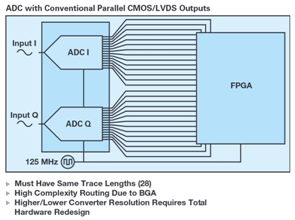
Figure 2. Challenges in system design and interconnect using parallel CMOS or LVDS.
图2.使用并行CMOS或LVDS带来的系统设计与互连的挑战。
JESD204B OVERVIEW
JESD204B概述
The JESD204 data converter serial interface standard was created by the JEDEC Solid State Technology Association JC-16 Committee on Interface Technology with the goal of providing a higher speed serial interface for data converters to increase bandwidth and reduce the number of digital inputs and outputs between high speed data converters and other devices. The standard builds on 8b/10b encoding technology developed by IBM that eliminates the need for a frame clock and a data clock, enabling single line pair communications at a much higher speed.
史海拾趣
|
本帖最后由 paulhyde 于 2014-9-15 08:54 编辑 今年暑假,我有幸参加了全国大学生电子设计大赛的培训.在学校提供的实验室里,我度过了紧张而又刺激的两个月时间.在有限的时间里,我学到了无穷的知识, 仿佛胜过两年的大学学业.在实验室,我感受到了前所 ...… 查看全部问答> |
|
一、利用离线存储来提高设备的使用寿命。 存储在磁带设备上的数据一般可能很少用到。如企业需要对数据库等应用软件的数据进行备份。此时可以将数据备份到磁带设备上。根据惯例,一般一天24个小时这个磁带设备可能就只需要半个小时。 ...… 查看全部问答> |
|
我在MDK下用Ulink2调试STM32,调试一次退出后,再进入调试模式就提示有问题,必须复位MCU才行。 烧写也是,烧写后必须复位MCU才能进入调试或者再烧写。 复位电路是参照的万利的板子,不知道要设置哪里。 谢谢了。… 查看全部问答> |
|
M3没法下载程序了 显示 Could not initialize target device!Please power cycle the board and try again! 哪位朋友知道为什么啊?非常感谢… 查看全部问答> |
|
Sitara AM335x通用EVM硬件用户指南 CN_PDF 介绍 本文档介绍了AM335x评估模块(EVM)(TMDXEVM3358)这是基于德州仪器AM335x处理器的硬件体系结构。该EVM通常也被称为AM335x通用(GP)EVM。描述 AM335x通用EVM是一个独立的测试,开发和评估模块系统,它使开发人员能够编写周围的AM335x处理 ...… 查看全部问答> |
|
搭建的CPU使用的时钟为100MHz,软件中连续使用IO_WR()直接对IO操作(赋值1和0)发现运行的时间不是10ns,而是1us左右,程序放在DDR中跑得,效率怎么会这么低,将程序放在片内跑,同样的程序,跑出来也不是10ns,而是接近200ns,相当于5M时钟在运行 ...… 查看全部问答> |