



历史上的今天
今天是:2025年03月11日(星期二)
2019年03月11日 | STM32 UVC学习笔记1
2019-03-11 来源:eefocus
主机环境:Windows 7 SP1
开发环境:MDK5.18
目标板:STM32F103C8T6
开发库:STM32F1Cube库和STM32_USB_Device_Library
距离之前的STM32 USB学习又过去了N个月,想起最初想学习USB的初衷就是学习一下UVC协议,了解一下图像的传输,在逛STM32社区的时候有看到一句话:以前使用单片机必须熟悉I2C、SPI、UART等通信协议,但现在也必须熟悉USB通信协议了,因为目前主流的设备几乎都是USB接口的,在USB接口上又可以实现I2C、SPI、UART等协议,USB不可谓不强大。废话就到这吧。
经过之前的USB学习,基本上了解了STM32的USB外设,因此开始了USB接口之上的UVC的学习,中间可以说是一波三折,其中芯片还烧坏了一次,又买的新的芯片焊上去的,历史的经验告诉我们,学习一个新的东西,总不是一帆风顺的,UVC全程为USB Video Class--USB视频设备类,用于实现在USB接口上传输视频的功能,目前的UVC规范版本是1.5,可以从USB官网下载,其清单如下:
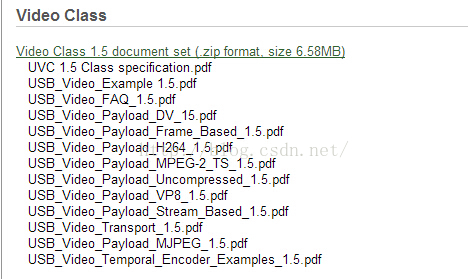
其中我们需要熟悉的是UVC 1.5 Class Specification文档,USB_Video_Example 1.5文档以及USB_Video_Payload_XX_1.5(一种)文档,由于是初学者因此这里我看的是USB_Video_Payload_MJPEG_1.5文档,也建议大家先学习该文档,毕竟新东西要从简单的开始学起。USB_Video_Example_1.5文档给出了使用MJPEG负载的示例,我们敲代码时可以用到其中的描述符。
UVC规范中说明了一个UVC设备需要实现一个VC(Video Control)接口和若干个VS(Video Streaming)接口,其中VC接口用于控制设备的功能,而VS接口用于传输视频数据流。在最简单的情况下,有一个VC接口和一个VS接口,这就是接下来我们需要实现的。在未熟悉UVC规范的情况下我们也可以把代码框架搭建起来,STM32_USB_Device_Library库是一个很方便扩展的库,因为它把内核和设备类区分出来了,我们要想实现UVC就要新建一个设备类文件夹,刚好UVC和UAC有那么一点类似之处,我们可以把AUDIO中的文件拷贝一份到UVC文件夹下并修改文件名,这样我们就有了usbd_uvc以及usbd_uvc_if文件了,至于usbd_conf,usbd_desc文件只要把之前的VCP例程中的文件稍作修改就可以使用了,这样我们的UVC代码框架就算完成了,在代码实现中就要参看Example文档一步步来完善就可以了,由于是首次学习,UVC的代码框架并不是很好,因此usbd_uvc_if文件其实是没有用到的,在以后再修改吧。因为在实现中,我们只需要把视频流数据发往USB主机即可,没有什么其他的功能要实现,当然在以后有更多功能要求时类接口文件就需要好好实现了,其中usbd_uvc_if.h文件内容如下:
/**
******************************************************************************
* @file USB_Device/UVC_Standalone/Inc/usbd_uvc_if.h
* @author MCD Application Team
* @version V1.2.0
* @date 19-June-2015
* @brief Header for usbd_uvc_if.c file.
******************************************************************************
* @attention
*
*
© COPYRIGHT(c) 2015 STMicroelectronics
*
* Licensed under MCD-ST Liberty SW License Agreement V2, (the "License");
* You may not use this file except in compliance with the License.
* You may obtain a copy of the License at:
*
* http://www.st.com/software_license_agreement_liberty_v2
*
* Unless required by applicable law or agreed to in writing, software
* distributed under the License is distributed on an "AS IS" BASIS,
* WITHOUT WARRANTIES OR CONDITIONS OF ANY KIND, either express or implied.
* See the License for the specific language governing permissions and
* limitations under the License.
*
******************************************************************************
*/
/* Define to prevent recursive inclusion -------------------------------------*/
#ifndef __USBD_UVC_IF_H
#define __USBD_UVC_IF_H
/* Includes ------------------------------------------------------------------*/
#include "usbd_uvc.h"
/* Exported types ------------------------------------------------------------*/
/* Exported constants --------------------------------------------------------*/
extern USBD_UVC_ItfTypeDef USBD_UVC_fops;
/* Exported macro ------------------------------------------------------------*/
/* Exported functions ------------------------------------------------------- */
#endif /* __USBD_UVC_IF_H */
/************************ (C) COPYRIGHT STMicroelectronics *****END OF FILE****/
可以看到文件基本上是空的,而usbd_uvc_if.c文件内容如下:
/**
******************************************************************************
* @file usbd_uvc_if.c
* @author MCD Application Team
* @version V2.4.1
* @date 19-June-2015
* @brief Generic media access Layer.
******************************************************************************
* @attention
*
*
© COPYRIGHT 2015 STMicroelectronics
*
* Licensed under MCD-ST Liberty SW License Agreement V2, (the "License");
* You may not use this file except in compliance with the License.
* You may obtain a copy of the License at:
*
* http://www.st.com/software_license_agreement_liberty_v2
*
* Unless required by applicable law or agreed to in writing, software
* distributed under the License is distributed on an "AS IS" BASIS,
* WITHOUT WARRANTIES OR CONDITIONS OF ANY KIND, either express or implied.
* See the License for the specific language governing permissions and
* limitations under the License.
*
******************************************************************************
*/
/* Includes ------------------------------------------------------------------*/
#include "main.h"
/** @addtogroup STM32_USB_DEVICE_LIBRARY
* @{
*/
/** @defgroup USBD_UVC
* @brief usbd core module
* @{
*/
/** @defgroup USBD_UVC_Private_TypesDefinitions
* @{
*/
/**
* @}
*/
/** @defgroup USBD_UVC_Private_Defines
* @{
*/
/**
* @}
*/
/** @defgroup USBD_UVC_Private_Macros
* @{
*/
/**
* @}
*/
/** @defgroup USBD_UVC_Private_FunctionPrototypes
* @{
*/
static int8_t UVC_Itf_Init (void);
static int8_t UVC_Itf_DeInit (void);
static int8_t UVC_Itf_Control (uint8_t cmd, uint8_t* pbuf, uint16_t length);
USBD_UVC_ItfTypeDef USBD_UVC_fops =
{
UVC_Itf_Init,
UVC_Itf_DeInit,
UVC_Itf_Control,
};
/* TIM handler declaration */
/* USB handler declaration */
/* Private functions ---------------------------------------------------------*/
/**
* @brief TEMPLATE_Init
* Initializes the UVC media low layer
* @param None
* @retval Result of the operation: USBD_OK if all operations are OK else USBD_FAIL
*/
static int8_t UVC_Itf_Init(void)
{
/*
Add your initialization code here
*/
return (0);
}
/**
* @brief TEMPLATE_DeInit
* DeInitializes the UVC media low layer
* @param None
* @retval Result of the operation: USBD_OK if all operations are OK else USBD_FAIL
*/
static int8_t UVC_Itf_DeInit(void)
{
/*
Add your deinitialization code here
*/
return (0);
}
/**
* @brief TEMPLATE_Control
* Manage the UVC class requests
* @param Cmd: Command code
* @param Buf: Buffer containing command data (request parameters)
* @param Len: Number of data to be sent (in bytes)
* @retval Result of the operation: USBD_OK if all operations are OK else USBD_FAIL
*/
static int8_t UVC_Itf_Control (uint8_t cmd, uint8_t* pbuf, uint16_t length)
{
return (0);
}
/**
* @}
*/
/**
* @}
*/
/**
* @}
*/
/************************ (C) COPYRIGHT STMicroelectronics *****END OF FILE****/
该文件也是空,但我们在UVC类文件中需要用到这个接口(为了日后扩展使用),当然如果闲麻烦的话这两个文件可以直接删除的。代码实现还是从最简单的开始即usbd_desc文件,头文件当然不需要改动了,我们改动的只有usbd_desc.c文件,在该文件中我们改动的也只是描述符而已,如下:
/**
******************************************************************************
* @file USB_Device/UVC_Standalone/Src/usbd_desc.c
* @author MCD Application Team
* @version V1.2.0
* @date 19-June-2015
* @brief This file provides the USBD descriptors and string formating method.
******************************************************************************
* @attention
*
*
© COPYRIGHT(c) 2015 STMicroelectronics
*
* Licensed under MCD-ST Liberty SW License Agreement V2, (the "License");
* You may not use this file except in compliance with the License.
* You may obtain a copy of the License at:
*
* http://www.st.com/software_license_agreement_liberty_v2
*
* Unless required by applicable law or agreed to in writing, software
* distributed under the License is distributed on an "AS IS" BASIS,
* WITHOUT WARRANTIES OR CONDITIONS OF ANY KIND, either express or implied.
* See the License for the specific language governing permissions and
* limitations under the License.
*
******************************************************************************
*/
/* Includes ------------------------------------------------------------------*/
#include "usbd_core.h"
#include "usbd_desc.h"
#include "usbd_conf.h"
/* Private typedef -----------------------------------------------------------*/
/* Private define ------------------------------------------------------------*/
#define USBD_VID 0x1985
#define USBD_PID 0x1707
#define USBD_LANGID_STRING 0x409 //English(United States)
#define USBD_MANUFACTURER_STRING "ANOBODYKEY"
#define USBD_PRODUCT_FS_STRING "STM32 Video Streaming in FS Mode"
#define USBD_CONFIGURATION_FS_STRING "UVC Config"
#define USBD_INTERFACE_FS_STRING "UVC Interface"
/* Private macro -------------------------------------------------------------*/
/* Private function prototypes -----------------------------------------------*/
uint8_t *USBD_UVC_DeviceDescriptor(USBD_SpeedTypeDef speed, uint16_t *length);
uint8_t *USBD_UVC_LangIDStrDescriptor(USBD_SpeedTypeDef speed, uint16_t *length);
uint8_t *USBD_UVC_ManufacturerStrDescriptor(USBD_SpeedTypeDef speed, uint16_t *length);
uint8_t *USBD_UVC_ProductStrDescriptor(USBD_SpeedTypeDef speed, uint16_t *length);
uint8_t *USBD_UVC_SerialStrDescriptor(USBD_SpeedTypeDef speed, uint16_t *length);
uint8_t *USBD_UVC_ConfigStrDescriptor(USBD_SpeedTypeDef speed, uint16_t *length);
uint8_t *USBD_UVC_InterfaceStrDescriptor(USBD_SpeedTypeDef speed, uint16_t *length);
#ifdef USB_SUPPORT_USER_STRING_DESC
uint8_t *USBD_UVC_USRStringDesc(USBD_SpeedTypeDef speed, uint8_t idx, uint16_t *length);
#endif /* USB_SUPPORT_USER_STRING_DESC */
/* Private variables ---------------------------------------------------------*/
USBD_DescriptorsTypeDef UVC_Desc = {
USBD_UVC_DeviceDescriptor,
USBD_UVC_LangIDStrDescriptor,
USBD_UVC_ManufacturerStrDescriptor,
USBD_UVC_ProductStrDescriptor,
USBD_UVC_SerialStrDescriptor,
USBD_UVC_ConfigStrDescriptor,
USBD_UVC_InterfaceStrDescriptor,
};
const uint8_t hUSBDDeviceDesc[USB_LEN_DEV_DESC]= {
0x12, /* bLength */
USB_DESC_TYPE_DEVICE, /* bDescriptorType */
0x00, /* bcdUSB */
0x02,
0xEF, /* bDeviceClass */
0x02, /* bDeviceSubClass */
0x01, /* bDeviceProtocol */
USB_MAX_EP0_SIZE, /* bMaxPacketSize*/
LOBYTE(USBD_VID), /* idVendor */
HIBYTE(USBD_VID), /* idVendor */
LOBYTE(USBD_PID), /* idVendor */
HIBYTE(USBD_PID), /* idVendor */
0x00, /* bcdDevice rel. 2.00 */
0x02,
USBD_IDX_MFC_STR, /* Index of manufacturer string */
USBD_IDX_PRODUCT_STR, /* Index of product string */
USBD_IDX_SERIAL_STR, /* Index of serial number string */
USBD_MAX_NUM_CONFIGURATION /* bNumConfigurations */
}; /* USB_DeviceDescriptor */
/* USB Standard Device Descriptor */
const uint8_t USBD_LangIDDesc[USB_LEN_LANGID_STR_DESC]= {
USB_LEN_LANGID_STR_DESC,
USB_DESC_TYPE_STRING,
LOBYTE(USBD_LANGID_STRING),
HIBYTE(USBD_LANGID_STRING),
};
uint8_t USBD_StringSerial[USB_SIZ_STRING_SERIAL] =
{
USB_SIZ_STRING_SERIAL,
USB_DESC_TYPE_STRING,
};
uint8_t USBD_StrDesc[USBD_MAX_STR_DESC_SIZ];
/* Private functions ---------------------------------------------------------*/
static void IntToUnicode (uint32_t value , uint8_t *pbuf , uint8_t len);
static void Get_SerialNum(void);
/**
* @brief Returns the device descriptor.
* @param speed: Current device speed
* @param length: Pointer to data length variable
* @retval Pointer to descriptor buffer
*/
uint8_t *USBD_UVC_DeviceDescriptor(USBD_SpeedTypeDef speed, uint16_t *length)
{
*length = sizeof(hUSBDDeviceDesc);
return (uint8_t *)hUSBDDeviceDesc;
}
/**
* @brief Returns the LangID string descriptor.
* @param speed: Current device speed
* @param length: Pointer to data length variable
* @retval Pointer to descriptor buffer
*/
uint8_t *USBD_UVC_LangIDStrDescriptor(USBD_SpeedTypeDef speed, uint16_t *length)
{
*length = sizeof(USBD_LangIDDesc);
return (uint8_t *)USBD_LangIDDesc;
}
/**
* @brief Returns the product string descriptor.
* @param speed: Current device speed
* @param length: Pointer to data length variable
* @retval Pointer to descriptor buffer
*/
uint8_t *USBD_UVC_ProductStrDescriptor(USBD_SpeedTypeDef speed, uint16_t *length)
{
USBD_GetString((uint8_t *)USBD_PRODUCT_FS_STRING, USBD_StrDesc, length);
return USBD_StrDesc;
}
/**
* @brief Returns the manufacturer string descriptor.
* @param speed: Current device speed
* @param length: Pointer to data length variable
* @retval Pointer to descriptor buffer
*/
uint8_t *USBD_UVC_ManufacturerStrDescriptor(USBD_SpeedTypeDef speed, uint16_t *length)
{
USBD_GetString((uint8_t *)USBD_MANUFACTURER_STRING, USBD_StrDesc, length);
return USBD_StrDesc;
}
/**
* @brief Returns the serial number string descriptor.
* @param speed: Current device speed
* @param length: Pointer to data length variable
* @retval Pointer to descriptor buffer
*/
uint8_t *USBD_UVC_SerialStrDescriptor(USBD_SpeedTypeDef speed, uint16_t *length)
{
*length = USB_SIZ_STRING_SERIAL;
/* Update the serial number string descriptor with the data from the unique ID*/
Get_SerialNum();
return USBD_StringSerial;
}
/**
* @brief Returns the configuration string descriptor.
* @param speed: Current device speed
* @param length: Pointer to data length variable
* @retval Pointer to descriptor buffer
*/
uint8_t *USBD_UVC_ConfigStrDescriptor(USBD_SpeedTypeDef speed, uint16_t *length)
{
USBD_GetString((uint8_t *)USBD_CONFIGURATION_FS_STRING, USBD_StrDesc, length);
return USBD_StrDesc;
}
/**
* @brief Returns the interface string descriptor.
* @param speed: Current device speed
* @param length: Pointer to data length variable
* @retval Pointer to descriptor buffer
*/
uint8_t *USBD_UVC_InterfaceStrDescriptor(USBD_SpeedTypeDef speed, uint16_t *length)
{
USBD_GetString((uint8_t *)USBD_INTERFACE_FS_STRING, USBD_StrDesc, length);
return USBD_StrDesc;
}
/**
* @brief Create the serial number string descriptor
* @param None
* @retval None
*/
static void Get_SerialNum(void)
{
uint32_t deviceserial0, deviceserial1, deviceserial2;
deviceserial0 = *(uint32_t*)DEVICE_ID1;
deviceserial1 = *(uint32_t*)DEVICE_ID2;
deviceserial2 = *(uint32_t*)DEVICE_ID3;
deviceserial0 += deviceserial2;
if (deviceserial0 != 0)
{
IntToUnicode (deviceserial0, &USBD_StringSerial[2] ,8);
IntToUnicode (deviceserial1, &USBD_StringSerial[18] ,4);
}
}
/**
* @brief Convert Hex 32Bits value into char
* @param value: value to convert
* @param pbuf: pointer to the buffer
* @param len: buffer length
* @retval None
*/
static void IntToUnicode (uint32_t value , uint8_t *pbuf , uint8_t len)
{
uint8_t idx = 0;
for( idx = 0 ; idx < len ; idx ++)
{
if( ((value >> 28)) < 0xA )
{
pbuf[ 2* idx] = (value >> 28) + '0';
}
else
{
pbuf[2* idx] = (value >> 28) + 'A' - 10;
}
value = value << 4;
pbuf[ 2* idx + 1] = 0;
}
}
/************************ (C) COPYRIGHT STMicroelectronics *****END OF FILE****/
这是从之前的VCP例程中的文件修改过来的,其中VID和PID自己随便修改吧,其中的设备描述符就需要我们注意了,这里面的内容就是我从Example文件中拷贝的,Example文档中提供了2个示例,这里我参考的是第一个示例Destop Video Camera Example,当然参考哪个示例都是可以的,该示例的框架图如下所示:
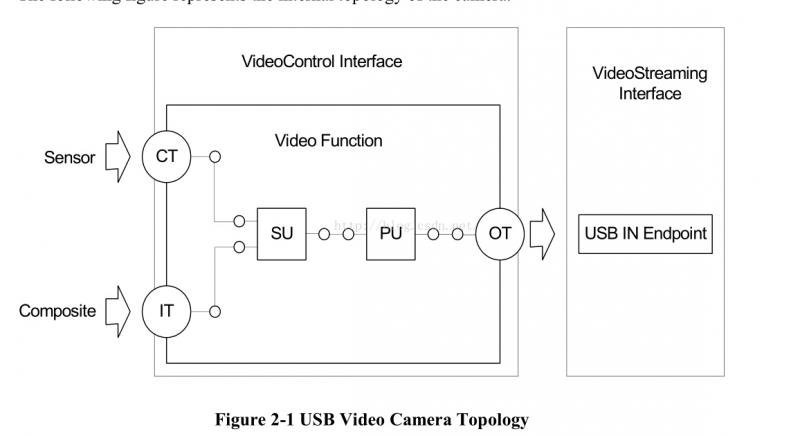
图中的概念缩写大家可以去看UVC1.5的协议规范,都有介绍的,该图只是作为参考,我在实现中省略了很多中间环节的,为了简洁而已。设备描述符的简介如下:
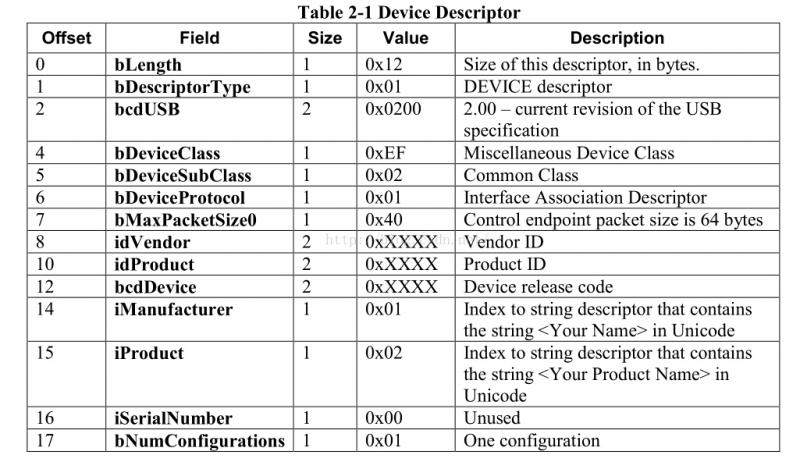
可以看到代码中的实现跟示例是一致的,接下来就是配置描述符,也是重中之重,也是我们修改较多的地方,描述符如下
/* USB UVC device Configuration Descriptor */
static uint8_t USBD_UVC_CfgDesc[USB_UVC_CONFIG_DESC_SIZ] =
{
/*Configuration Descriptor*/
0x09, /* bLength: Configuation Descriptor size */
USB_DESC_TYPE_CONFIGURATION, /* bDescriptorType: Configuration */
LOBYTE(USB_UVC_CONFIG_DESC_SIZ), /* wTotalLength: Bytes returned */
HIBYTE(USB_UVC_CONFIG_DESC_SIZ),
0x02, /*bNumInterfaces: 2 interface*/
0x01, /*bConfigurationValue: Configuration value*/
USBD_IDX_CONFIG_STR, /*iConfiguration: Index of string descriptor describing the configuration*/
0x80, /*bmAttributes: bus powered device */
0xFA, /*MaxPower 500 mA: this current is used for detecting Vbus*/
/* 09 */
/*---------------------------------------------------------------------------*/
/*Interface Association Descriptor*/
0x08, /* bLength: Interface Association Descriptor size */
USB_DESC_TYPE_INTERFACE_ASSOCIATION, /* bDescritorType: Interface Association */
0x00, /* bFirstInterface: VideoControl Interface ID */
0x02, /* bInterfaceCount: 2 Video Interface */
0x0E, /* bFunctionClass: CC_VIDEO */
0x03, /* bFunctionSubClass: SC_VIDEO_INTERFACE_COLLECTION */
0x00, /* bFunctionProtocol: PC_PROTOCOL_UNDEFINED */
USBD_IDX_INTERFACE_STR, /* iFunction: Index of string descriptor descripting the function */
/*Standard VC Interface Descriptor*/
0x09, /* bLenght: Standard VC Interface Descriptor size */
USB_DESC_TYPE_INTERFACE, /*bDescriptorType: interface */
0x00, /* bInterfaceNumber: interface ID */
0x00, /* bAlternateSetting: Alternate setting */
0x00, /* bNumEndpoints: no endpoint */
0x0E, /* bInterfaceClass: CC_VIDEO */
0x01, /* bInterfaceSubClass: SC_VIDEOCONTROL */
0x00, /* bInterfacePortocol: PC_PROTOCOL_15 */
USBD_IDX_INTERFACE_STR, /*iInterface: Index of string descriptor descripting the interface */
/*Class-specific VC Interface Header Descriptor*/
0x0D, /* bLength: Class-specific VC Interface Header Descriptor size */
0x24, /* bDescriptorType: CS_INTERFACE */
0x01, /* bDescriptorSubType: VC_HEADER */
0x10, /* bcdUVC: UVC1.5 revision */
0x01,
0x27, /* wTotalLength: total size of class-specific descriptors */
0x00,
0x80, /* dwClockFrequency: deprecated */
0x8D,
0x5B,
0x00,
0x01, /* bInCollection: number of streaming interfaces */
0x01, /* baInterfaceNr(1): VideoStreaming interface 1 belongs to VC interface */
/*Input Terminal Descriptor Composite*/
0x11, /* bLength: Input Terminal Descriptor size */
0x24, /* bDescriptorType: CS_INTERFACE */
0x02, /* bDescriptorSubType: VC_INPUT_TERMINAL */
0x01, /* bTerminalID: Terminal ID */
0x01, /* wTerminalType: ITT_CAMERA */
0x02,
0x00, /* bAssocTerminal: no association */
0x00, /*iTerminal: index of string descriptor descripting the terminal */
0x00, /* wObjectiveFocalLengthMin: No optical zoom supported */
0x00,
0x00, /* wObjectiveFocalLengthMax: No optical zoom supported */
0x00,
0x00, /* wOcularFocalLength: No optical zoom supported */
0x00,
0x02, /* bControlSize: this terminal doesn't implement any controls */
0x00, /* bmControls: No controls are supported */
0x00,
/*Output Terminal Descriptor*/
0x09, /* bLength: Output Terminal Descriptor size */
0x24, /* bDescriptorType: CS_INTERFACE */
0x03, /* bDescriptorSubType: VC_OUTPUT_TERMINAL */
0x02, /* bTerminalID: Terminal ID */
0x01, /* wTerminalType: TT_STREAMING */
0x01,
0x00, /* bAssocTerminal: no association */
0x01, /* bSourceID: connect to the input terminal output pin */
0x00, /*iTerminal: index of string descriptor descripting the terminal */
/*---------------------------------------------------------------------------*/
/*Standard VS Interface Alternate 0 setting Descriptor*/
0x09, /* bLength: Standard VS Interface Descriptor size */
USB_DESC_TYPE_INTERFACE, /* bDescriptorType: INTERFACE */
0x01, /* bInterfaceNumber: Interface ID */
0x00, /* bAlternateSetting: index of this alternate setting */
0x00, /* bNumEndpoints: 0 endpoint */
0x0E, /* bInterfaceClass: CC_VIDEO */
0x02, /* bInterfaceSubClass: SC_VIDEOSTREAMING */
0x00, /* bInterfaceProtocol: PC_PROTOCOL_15 */
USBD_IDX_INTERFACE_STR, /*iInterface: Index of string descriptor descripting the interface */
/*Class-specific VS Header Descriptor*/
0x0E, /* bLength: Class-specific VS Header Descriptor size */
0x24, /* bDescriptorType: CS_INTERFACE */
0x01, /* bDescriptorSubType: VS_INPUT_HEADER */
0x01, /* bNumFormats: one format descriptor follows */
0x3F,//0x45, /* wTotalLength: Total size of class-specific VS interface descriptors */
0x00,
UVC_ISO_DATA_EP, /* bEndpointAddress: address of isochronour video data endpoint */
0x00, /* bmInfo: no dynamic format change supported */
0x02, /* bTerminalLink: the terminal ID of output Terminal */
0x00, /* bStillCaptureMethod: no supports still image capture method */
0x00, /* bTriggerSupport: no supports hardware trigger */
0x00, /* bTriggerUsage: initiate still image capture */
0x01, /* bControlSize: the size of bmaControls field */
0x00, /* bmaControls: no VS specific controls are supported */
/*Payload Format Descriptor*/
0x0B, /* blength: Payload Format Descriptor size */
0x24, /* bDescriptorType: CS_INTERFACE */
0x06, /* bDescriptorSubType: VS_FORMAT_MJPEG */
0x01, /* bFormatIndex: index of the format descriptor */
0x01, /* bNumFrameDescriptor: number of frame descriptors */
0x01, /* bmFlags: FixedSizeSamples */
0x01, /* bDefaultFrameIndex: */
0x00, /* bAspectRatioX: not required */
0x00, /* bAspectRatioY: not required */
0x00, /* bInterlaceFlags: non-interlaced stream */
0x00, /* bCopyProtect: no restrictions */
/*Class-specific VS Frame Descriptor*/
0x26, /* bLength: Class-specific VS Frame Descriptor size */
0x24, /* bDescriptorType: CS_INTERFACE */
0x07, /* bDescriptorSubType: VS_FRAME_MJPEG */
0x01, /* bFrameIndex: index of frame descriptor */
0x02, /* bmCapabilities:still image capture method 0 supported,fixed frame-rate */
0x80, /* wWidth: frame width */
0x00,
0xA0, /* wHeight: frame height */
0x00,
0x00, /* dwMinBitRate: */
0xB0,
0x04,
0x00,
0x00, /* dwMaxBitRate: */
0x00,
0x4B,
0x00,
0x00, /* dwMaxVideoFrameBufSize: in bytes */
0xA0,
0x00,
0x00,
0x2A, /* dwDefaultFrameInterval: */
0x2C,
0x0A,
0x00,
0x00, /* bFrameIntervalType: Continuous frame interval */
0x2A, /* dwMinFrameInterval: */
0x2C,
0x0A,
0x00,
0x2A, /* dwMaxFrameInterval: */
0x2C,
0x0A,
0x00,
0x00, /* dwFrameIntervalSetp: no frame interval step supported */
0x00,
0x00,
0x00,
/*---------------------------------------------------------------------------*/
/*Standard VS Interface Alternate setting 1 Descriptor*/
0x09, /* bLength: Standard VS Interface Descriptor size */
USB_DESC_TYPE_INTERFACE, /* bDescriptorType: INTERFACE */
0x01, /* bInterfaceNumber: Interface ID */
0x01, /* bAlternateSetting: index of this alternate setting */
0x01, /* bNumEndpoints: 1 endpoint */
0x0E, /* bInterfaceClass: CC_VIDEO */
0x02, /* bInterfaceSubClass: SC_VIDEOSTREAMING */
0x00, /* bInterfaceProtocol: PC_PROTOCOL_15 */
USBD_IDX_INTERFACE_STR, /*iInterface: Index of string descriptor descripting the interface */
/*Endpoint Descriptor*/
0x07, /* bLength: Endpoint Descriptor size */
USB_DESC_TYPE_ENDPOINT, /* bDescriptorType: ENDPOINT */
UVC_ISO_DATA_EP, /* bEndpointAddress: address of isochronour video data endpoint */
0x05, /* bmAttributes: Isochronous transfer Asynchronous data type */
LOBYTE(UVC_ISO_DATA_PACKET_SIZE), /* wMaxPacketSize: */
HIBYTE(UVC_ISO_DATA_PACKET_SIZE),
0x01, /* bInterval: */
/********** Descriptor of UVC interface 0 Alternate setting 0 **************/
};
对比之前的拓扑图就可以知道这里使用到了CT(相机终端),去掉了SU(选择单元)和PU(处理单元),CT直接连至OT(输出终端),这里虽然是参考的UVC1.5的文档,但最后我给改成了UVC1.1,UVC1.5其实和UVC1.1相差不多,可以使用UVCView软件来检查描述符是否正确,配置的具体含义看代码中的注释即可明白。目前UVCView只能检查UVC1.1协议,如果使用的是UVC1.5协议,该软件会提示错误,但其实并没有错误。这里是使用端点0作为默认的控制端点,使用端点1来发送视频数据流,且端点配置成同步端点。端点大小的取值在后面会解释,这里需要注意的是使用同步端点的话就一定要使用两种接口配置,默认情况下使用接口配置0,默认接口配置中不能包含数据负载非0的同步端点,只能在交替配置中包含同步端点,关于USB不同的传输类型的详细说明可以查看USB2.0协议规范的第5章节,该章节我可是仔细阅读了一下,还试着翻译了一下便于理解。也希望大家可以看看该章节以便对各个传输类型有所了解。STM32的USB模块支持全速模式即通信速率为12MBit/s,也就是1.5MByte/s,由于我的单板啥外设也没得,因此图像数据只能存储在单片机中,从STM32F1Cube中找了一张128*160的图片,来实现以15fps帧传输该图片到USB主机,该图片经过压缩成jpeg格式大概为9K字节,每秒15帧的话也就是每秒传输9K*15=135K字节,USB2.0全速模式下把1S分成了1000个微帧,即1ms为一个微帧,视频数据流在微帧内传输,全速设备在每个微帧内可以进行一次同步传输,由此得知,一次微帧我们需要传输135个字节,这里我把同步端点的最大包大小设置成150字节,足以传输这张图片了,有关为什么这里是那一张JPEG图片来传输可以查看USB_Video_Payload_MJPEG文档,MJPEG就是把一幅幅JPEG格式的帧连续的播放,因此为了简介,这里就是把一张JPEG图片连续发送到USB主机。对了,在配置描述符中有用到一个接口连接描述符,在USB设备库中是没有定义,因此把该定义加到USB设备库中,即usbd_def.h文件中,如下:
#define USB_DESC_TYPE_DEVICE 1
#define USB_DESC_TYPE_CONFIGURATION 2
#define USB_DESC_TYPE_STRING 3
#define USB_DESC_TYPE_INTERFACE 4
#define USB_DESC_TYPE_ENDPOINT 5
#define USB_DESC_TYPE_DEVICE_QUALIFIER 6
#define USB_DESC_TYPE_OTHER_SPEED_CONFIGURATION 7
#define USB_DESC_TYPE_BOS 0x0F
#define USB_DESC_TYPE_INTERFACE_ASSOCIATION 11
至此,我们知道了所用的端点数:2个,端点类型:一个控制端点和一个同步端点,我们就可以修改usbd_conf文件了,usbd_conf.h文件如下:
/**
******************************************************************************
* @file USB_Device/UVC_Standalone/Inc/usbd_conf.h
* @author MCD Application Team
* @version V1.2.0
* @date 19-June-2015
* @brief General low level driver configuration
******************************************************************************
* @attention
*
*
© COPYRIGHT(c) 2015 STMicroelectronics
*
* Licensed under MCD-ST Liberty SW License Agreement V2, (the "License");
* You may not use this file except in compliance with the License.
* You may obtain a copy of the License at:
*
* http://www.st.com/software_license_agreement_liberty_v2
*
* Unless required by applicable law or agreed to in writing, software
* distributed under the License is distributed on an "AS IS" BASIS,
* WITHOUT WARRANTIES OR CONDITIONS OF ANY KIND, either express or implied.
* See the License for the specific language governing permissions and
* limitations under the License.
*
******************************************************************************
*/
/* Define to prevent recursive inclusion -------------------------------------*/
#ifndef __USBD_CONF_H
#define __USBD_CONF_H
/* Includes ------------------------------------------------------------------*/
#include "stm32f1xx_hal.h"
#include
#include
#include
/* Exported types ------------------------------------------------------------*/
/* Exported constants --------------------------------------------------------*/
/* Common Config */
#define USBD_MAX_NUM_INTERFACES 1
#define USBD_MAX_NUM_CONFIGURATION 1
#define USBD_MAX_STR_DESC_SIZ 0x100
#define USBD_SUPPORT_USER_STRING 0
#define USBD_SELF_POWERED 0
#define USBD_DEBUG_LEVEL 0
/* VIDEO Class Config */
#define USBD_VIDEO_FPS 15
#define ENDP1_BUF0ADDR (0xC0)
#define ENDP1_BUF1ADDR (0xC0)
#define VIDEO_IN_TX_ADDRESS (ENDP1_BUF0ADDR | (ENDP1_BUF1ADDR<<16))
/* Exported macro ------------------------------------------------------------*/
/* Memory management macros */
/* For footprint reasons and since only one allocation is handled in the AUDIO class
driver, the malloc/free is changed into a static allocation method */
void *USBD_static_malloc(uint32_t size);
void USBD_static_free(void *p);
#define MAX_STATIC_ALLOC_SIZE 40 /*Video Class Driver Structure size*/
#define USBD_malloc (uint32_t *)USBD_static_malloc
#define USBD_free USBD_static_free
#define USBD_memset /* Not used */
#define USBD_memcpy /* Not used */
/* DEBUG macros */
#if (USBD_DEBUG_LEVEL > 0)
#define USBD_UsrLog(...) printf(__VA_ARGS__);\
printf("\n");
#else
#define USBD_UsrLog(...)
#endif
#if (USBD_DEBUG_LEVEL > 1)
#define USBD_ErrLog(...) printf("ERROR: ") ;\
printf(__VA_ARGS__);\
printf("\n");
#else
#define USBD_ErrLog(...)
#endif
#if (USBD_DEBUG_LEVEL > 2)
#define USBD_DbgLog(...) printf("DEBUG : ") ;\
printf(__VA_ARGS__);\
printf("\n");
#else
#define USBD_DbgLog(...)
#endif
/* Exported functions ------------------------------------------------------- */
#endif /* __USBD_CONF_H */
/************************ (C) COPYRIGHT STMicroelectronics *****END OF FILE****/
该文件修改不大,首先是修改端点的缓冲区地址,这里是参考UAC文件来修改的,使用双缓冲,因为STM32在把端点配置成同步端点时就自动启用了双缓冲,一开始我还想着,不使用双缓冲而使用单缓冲结构发送视频数据流,结果在测试时一直有包相同的数据跟在我发送的有效数据后面,后来在查看STM32F103C8T6参考文档时才发现,使用同步端点必须要使用双缓冲,因此,这里要配置BUF0和BUF1地址,这两个地址配成一样或不一样都不影响,因为Cube库中只对外提供了一个接口USBD_LL_Transmit,因此在USB模块使用其中一个缓冲时,应用程序也无法灵活使用另一段缓冲,再有一个修改就是MAX_STATIC_ALLOC_SIZE把值改小了,因为这里是把数据发往USB主机并不需要接口很多数据,因此,UVC的类结构并不需要使用太多的内存,usbd_conf.c文件如下:
/**
******************************************************************************
* @file USB_Device/UVC_Standalone/Src/usbd_conf.c
* @author MCD Application Team
* @version V1.2.0
* @date 31-July-2015
* @brief This file implements the USB Device library callbacks and MSP
******************************************************************************
* @attention
*
*
© COPYRIGHT(c) 2015 STMicroelectronics
*
* Licensed under MCD-ST Liberty SW License Agreement V2, (the "License");
* You may not use this file except in compliance with the License.
* You may obtain a copy of the License at:
*
* http://www.st.com/software_license_agreement_liberty_v2
*
* Unless required by applicable law or agreed to in writing, software
* distributed under the License is distributed on an "AS IS" BASIS,
* WITHOUT WARRANTIES OR CONDITIONS OF ANY KIND, either express or implied.
* See the License for the specific language governing permissions and
* limitations under the License.
*
******************************************************************************
*/
/* Includes ------------------------------------------------------------------*/
#include "main.h"
/* Private typedef -----------------------------------------------------------*/
/* Private define ------------------------------------------------------------*/
/* Private macro -------------------------------------------------------------*/
/* Private variables ---------------------------------------------------------*/
PCD_HandleTypeDef hpcd;
/* Private function prototypes -----------------------------------------------*/
/* Private functions ---------------------------------------------------------*/
/*******************************************************************************
PCD BSP Routines
*******************************************************************************/
/**
* @brief Initializes the PCD MSP.
* @param hpcd: PCD handle
* @retval None
*/
void HAL_PCD_MspInit(PCD_HandleTypeDef *hpcd)
{
GPIO_InitTypeDef GPIO_InitStruct;
/* Enable the GPIOA clock */
__HAL_RCC_GPIOA_CLK_ENABLE();
/* Configure USB DM/DP pins */
GPIO_InitStruct.Pin = (GPIO_PIN_11 | GPIO_PIN_12);
GPIO_InitStruct.Mode = GPIO_MODE_AF_INPUT;
GPIO_InitStruct.Pull = GPIO_PULLUP;
GPIO_InitStruct.Speed = GPIO_SPEED_HIGH;
HAL_GPIO_Init(GPIOA, &GPIO_InitStruct);
/* Enable USB Clock */
__HAL_RCC_USB_CLK_ENABLE();
/* Set USB Interrupt priority */
HAL_NVIC_SetPriority(USB_LP_CAN1_RX0_IRQn, 7, 0);
/* Enable USB Interrupt */
HAL_NVIC_EnableIRQ(USB_LP_CAN1_RX0_IRQn);
}
/**
* @brief De-Initializes the PCD MSP.
* @param hpcd: PCD handle
* @retval None
*/
void HAL_PCD_MspDeInit(PCD_HandleTypeDef *hpcd)
{
/* Disable USB FS Clock */
__HAL_RCC_USB_CLK_DISABLE();
}
/*******************************************************************************
LL Driver Callbacks (PCD -> USB Device Library)
*******************************************************************************/
/**
* @brief SetupStage callback.
* @param hpcd: PCD handle
* @retval None
*/
void HAL_PCD_SetupStageCallback(PCD_HandleTypeDef *hpcd)
{
USBD_LL_SetupStage((USBD_HandleTypeDef*)hpcd->pData, (uint8_t *)hpcd->Setup);
}
/**
* @brief DataOut Stage callback.
* @param hpcd: PCD handle
* @param epnum: Endpoint Number
* @retval None
*/
void HAL_PCD_DataOutStageCallback(PCD_HandleTypeDef *hpcd, uint8_t epnum)
{
USBD_LL_DataOutStage((USBD_HandleTypeDef*)hpcd->pData, epnum, hpcd->OUT_ep[epnum].xfer_buff);
}
/**
* @brief DataIn Stage callback.
* @param hpcd: PCD handle
* @param epnum: Endpoint Number
* @retval None
*/
void HAL_PCD_DataInStageCallback(PCD_HandleTypeDef *hpcd, uint8_t epnum)
{
USBD_LL_DataInStage((USBD_HandleTypeDef*)hpcd->pData, epnum, hpcd->IN_ep[epnum].xfer_buff);
}
/**
* @brief SOF callback.
* @param hpcd: PCD handle
* @retval None
*/
void HAL_PCD_SOFCallback(PCD_HandleTypeDef *hpcd)
{
USBD_LL_SOF((USBD_HandleTypeDef*)hpcd->pData);
}
/**
* @brief Reset callback.
* @param hpcd: PCD handle
* @retval None
*/
void HAL_PCD_ResetCallback(PCD_HandleTypeDef *hpcd)
{
USBD_LL_SetSpeed((USBD_HandleTypeDef*)hpcd->pData, USBD_SPEED_FULL);
/* Reset Device */
USBD_LL_Reset((USBD_HandleTypeDef*)hpcd->pData);
}
/**
* @brief Suspend callback.
* @param hpcd: PCD handle
* @retval None
*/
void HAL_PCD_SuspendCallback(PCD_HandleTypeDef *hpcd)
{
/* Inform USB library that core enters in suspend Mode */
USBD_LL_Suspend((USBD_HandleTypeDef*)hpcd->pData);
}
/**
* @brief Resume callback.
* @param hpcd: PCD handle
* @retval None
*/
void HAL_PCD_ResumeCallback(PCD_HandleTypeDef *hpcd)
{
USBD_LL_Resume((USBD_HandleTypeDef*)hpcd->pData);
}
/**
* @brief ISOOUTIncomplete callback.
* @param hpcd: PCD handle
* @param epnum: Endpoint Number
* @retval None
*/
void HAL_PCD_ISOOUTIncompleteCallback(PCD_HandleTypeDef *hpcd, uint8_t epnum)
{
USBD_LL_IsoOUTIncomplete((USBD_HandleTypeDef*)hpcd->pData, epnum);
}
/**
* @brief ISOINIncomplete callback.
* @param hpcd: PCD handle
* @param epnum: Endpoint Number
* @retval None
*/
void HAL_PCD_ISOINIncompleteCallback(PCD_HandleTypeDef *hpcd, uint8_t epnum)
{
USBD_LL_IsoINIncomplete((USBD_HandleTypeDef*)hpcd->pData, epnum);
}
/**
* @brief ConnectCallback callback.
* @param hpcd: PCD handle
* @retval None
*/
void HAL_PCD_ConnectCallback(PCD_HandleTypeDef *hpcd)
{
USBD_LL_DevConnected((USBD_HandleTypeDef*)hpcd->pData);
}
/**
* @brief Disconnect callback.
* @param hpcd: PCD handle
* @retval None
*/
void HAL_PCD_DisconnectCallback(PCD_HandleTypeDef *hpcd)
{
USBD_LL_DevDisconnected((USBD_HandleTypeDef*)hpcd->pData);
}
/*******************************************************************************
LL Driver Interface (USB Device Library --> PCD)
*******************************************************************************/
/**
* @brief Initializes the Low Level portion of the Device driver.
* @param pdev: Device handle
* @retval USBD Status
*/
USBD_StatusTypeDef USBD_LL_Init(USBD_HandleTypeDef *pdev)
{
/* Set LL Driver parameters */
hpcd.Instance = USB;
hpcd.Init.dev_endpoints = 8; //STM32F103C8T6支持8个双向端点
hpcd.Init.ep0_mps = PCD_EP0MPS_64; //端点0支持的最大分组字节为64
hpcd.Init.phy_itface = PCD_PHY_EMBEDDED;
hpcd.Init.speed = PCD_SPEED_FULL; //USB2.0全速设备
hpcd.Init.low_power_enable = 0; //不使能低功耗模式
/* Link The driver to the stack */
hpcd.pData = pdev;
pdev->pData = &hpcd;
/* Initialize LL Driver */
HAL_PCD_Init((PCD_HandleTypeDef*)pdev->pData);
HAL_PCDEx_PMAConfig(pdev->pData , 0x00 , PCD_SNG_BUF, 0x40); //OUT端点
HAL_PCDEx_PMAConfig(pdev->pData , 0x80 , PCD_SNG_BUF, 0x80); //IN端点
HAL_PCDEx_PMAConfig(pdev->pData , UVC_ISO_DATA_EP, PCD_DBL_BUF, VIDEO_IN_TX_ADDRESS);
return USBD_OK;
}
/**
* @brief De-Initializes the Low Level portion of the Device driver.
* @param pdev: Device handle
* @retval USBD Status
*/
USBD_StatusTypeDef USBD_LL_DeInit(USBD_HandleTypeDef *pdev)
{
HAL_PCD_DeInit((PCD_HandleTypeDef*)pdev->pData);
return USBD_OK;
}
/**
* @brief Starts the Low Level portion of the Device driver.
* @param pdev: Device handle
* @retval USBD Status
*/
USBD_StatusTypeDef USBD_LL_Start(USBD_HandleTypeDef *pdev)
{
HAL_PCD_Start((PCD_HandleTypeDef*)pdev->pData);
return USBD_OK;
}
/**
* @brief Stops the Low Level portion of the Device driver.
* @param pdev: Device handle
* @retval USBD Status
*/
USBD_StatusTypeDef USBD_LL_Stop(USBD_HandleTypeDef *pdev)
{
HAL_PCD_Stop((PCD_HandleTypeDef*)pdev->pData);
return USBD_OK;
}
/**
* @brief Opens an endpoint of the Low Level Driver.
* @param pdev: Device handle
* @param ep_addr: Endpoint Number
* @param ep_type: Endpoint Type
* @param ep_mps: Endpoint Max Packet Size
* @retval USBD Status
*/
USBD_StatusTypeDef USBD_LL_OpenEP(USBD_HandleTypeDef *pdev,
uint8_t ep_addr,
uint8_t ep_type,
uint16_t ep_mps)
{
HAL_PCD_EP_Open((PCD_HandleTypeDef*)pdev->pData,
ep_addr,
ep_mps,
ep_type);
return USBD_OK;
}
/**
* @brief Closes an endpoint of the Low Level Driver.
* @param pdev: Device handle
* @param ep_addr: Endpoint Number
* @retval USBD Status
*/
USBD_StatusTypeDef USBD_LL_CloseEP(USBD_HandleTypeDef *pdev, uint8_t ep_addr)
{
HAL_PCD_EP_Close((PCD_HandleTypeDef*)pdev->pData, ep_addr);
return USBD_OK;
}
/**
* @brief Flushes an endpoint of the Low Level Driver.
* @param pdev: Device handle
* @param ep_addr: Endpoint Number
* @retval USBD Status
*/
USBD_StatusTypeDef USBD_LL_FlushEP(USBD_HandleTypeDef *pdev, uint8_t ep_addr)
{
HAL_PCD_EP_Flush((PCD_HandleTypeDef*)pdev->pData, ep_addr);
return USBD_OK;
}
/**
* @brief Sets a Stall condition on an endpoint of the Low Level Driver.
* @param pdev: Device handle
* @param ep_addr: Endpoint Number
* @retval USBD Status
*/
USBD_StatusTypeDef USBD_LL_StallEP(USBD_HandleTypeDef *pdev, uint8_t ep_addr)
{
HAL_PCD_EP_SetStall((PCD_HandleTypeDef*)pdev->pData, ep_addr);
return USBD_OK;
}
/**
* @brief Clears a Stall condition on an endpoint of the Low Level Driver.
* @param pdev: Device handle
* @param ep_addr: Endpoint Number
* @retval USBD Status
*/
USBD_StatusTypeDef USBD_LL_ClearStallEP(USBD_HandleTypeDef *pdev, uint8_t ep_addr)
{
HAL_PCD_EP_ClrStall((PCD_HandleTypeDef*)pdev->pData, ep_addr);
return USBD_OK;
}
/**
* @brief Returns Stall condition.
* @param pdev: Device handle
* @param ep_addr: Endpoint Number
* @retval Stall (1: Yes, 0: No)
*/
uint8_t USBD_LL_IsStallEP(USBD_HandleTypeDef *pdev, uint8_t ep_addr)
{
PCD_HandleTypeDef *hpcd = (PCD_HandleTypeDef*)pdev->pData;
if ((ep_addr & 0x80) == 0x80)
{
return hpcd->IN_ep[ep_addr & 0x7F].is_stall;
}
else
{
return hpcd->OUT_ep[ep_addr & 0x7F].is_stall;
}
}
/**
* @brief Assigns a USB address to the device.
* @param pdev: Device handle
* @param ep_addr: Endpoint Number
* @retval USBD Status
*/
USBD_StatusTypeDef USBD_LL_SetUSBAddress(USBD_HandleTypeDef *pdev, uint8_t dev_addr)
{
HAL_PCD_SetAddress((PCD_HandleTypeDef*)pdev->pData, dev_addr);
return USBD_OK;
}
/**
* @brief Transmits data over an endpoint.
* @param pdev: Device handle
* @param ep_addr: Endpoint Number
* @param pbuf: Pointer to data to be sent
* @param size: Data size
* @retval USBD Status
*/
USBD_StatusTypeDef USBD_LL_Transmit(USBD_HandleTypeDef *pdev,
uint8_t ep_addr,
uint8_t *pbuf,
uint16_t size)
{
HAL_PCD_EP_Transmit((PCD_HandleTypeDef*)pdev->pData, ep_addr, pbuf, size);
return USBD_OK;
}
/**
* @brief Prepares an endpoint for reception.
* @param pdev: Device handle
* @param ep_addr: Endpoint Number
* @param pbuf: Pointer to data to be received
* @param size: Data size
* @retval USBD Status
*/
USBD_StatusTypeDef USBD_LL_PrepareReceive(USBD_HandleTypeDef *pdev,
uint8_t ep_addr,
uint8_t *pbuf,
uint16_t size)
{
HAL_PCD_EP_Receive((PCD_HandleTypeDef*)pdev->pData, ep_addr, pbuf, size);
return USBD_OK;
}
/**
* @brief Returns the last transferred packet size.
* @param pdev: Device handle
* @param ep_addr: Endpoint Number
* @retval Recived Data Size
*/
uint32_t USBD_LL_GetRxDataSize(USBD_HandleTypeDef *pdev, uint8_t ep_addr)
{
return HAL_PCD_EP_GetRxCount((PCD_HandleTypeDef*)pdev->pData, ep_addr);
}
/**
* @brief Delays routine for the USB Device Library.
* @param Delay: Delay in ms
* @retval None
*/
void USBD_LL_Delay(uint32_t Delay)
{
HAL_Delay(Delay);
}
/**
* @brief static single allocation.
* @param size: size of allocated memory
* @retval None
*/
void *USBD_static_malloc(uint32_t size)
{
static uint32_t mem[MAX_STATIC_ALLOC_SIZE];
return mem;
}
/**
* @brief Dummy memory free
* @param *p pointer to allocated memory address
* @retval None
*/
void USBD_static_free(void *p)
{
}
/**
* @brief Software Device Connection
* @param hpcd: PCD handle
* @param state: connection state (0 : disconnected / 1: connected)
* @retval None
*/
void HAL_PCDEx_SetConnectionState(PCD_HandleTypeDef *hpcd, uint8_t state)
{
}
/************************ (C) COPYRIGHT STMicroelectronics *****END OF FILE****/
这里至改动了USBD_LL_Init()函数,配置端点1为双缓冲模式。同时在usbd_uvc.c文件中修改USBD_UVC_Init()函数打开所需的端点,如下:
/**
* @brief USBD_UVC_Init
* Initialize the UVC interface
* @param pdev: device instance
* @param cfgidx: Configuration index
* @retval status
*/
static uint8_t USBD_UVC_Init (USBD_HandleTypeDef *pdev,
uint8_t cfgidx)
{
uint8_t ret = 0;
USBD_UVC_HandleTypeDef *huvc;
USBD_LL_OpenEP(pdev, UVC_ISO_DATA_EP, USBD_EP_TYPE_ISOC, UVC_ISO_DATA_PACKET_SIZE);
pdev->pClassData = USBD_malloc(sizeof (USBD_UVC_HandleTypeDef));
if(pdev->pClassData == NULL)
{
ret = 1;
}
else
{
huvc = (USBD_UVC_HandleTypeDef*) pdev->pClassData;
/* Init physical Interface components */
((USBD_UVC_ItfTypeDef *)pdev->pUserData)->Init();
}
return ret;
}
/**
* @brief USBD_UVC_Init
* DeInitialize the UVC layer
* @param pdev: device instance
* @param cfgidx: Configuration index
* @retval status
*/
static uint8_t USBD_UVC_DeInit (USBD_HandleTypeDef *pdev,
uint8_t cfgidx)
{
/* Close EP 1 */
USBD_LL_CloseEP(pdev,UVC_ISO_DATA_EP);
/* DeInit physical Interface components */
if(pdev->pClassData != NULL)
{
((USBD_UVC_ItfTypeDef *)pdev->pUserData)->DeInit();
USBD_free(pdev->pClassData);
pdev->pClassData = NULL;
}
return USBD_OK;
}
至此,我们就可以实现UVC设备的枚举过程了。先到这吧,未完待续。。。
上一篇:STM32 UVC学习笔记2
下一篇:STM32 USB学习笔记9
史海拾趣
|
本人在网上找到了一个单片机应用PS-2键盘的实例的程序,这个程序是把读到的键值用1602液晶显示,现在我想去掉液晶,把单片机接8个LED灯,通过灯的亮灭来显示所读取键值的ASC码,不知道要怎么修改这个程序才能做到,望各位大虾指点… 查看全部问答> |
|
我今天怎么回复不了我自己的帖子,我的问题解决了本来想说明下情况,是如何解决的,然后结贴,结果我一回复就说我\"回复太快!如果你是恶意刷楼,将会受到严厉惩罚!\"我没有刷楼啊,到了下午再试试还是不行,这个怎么回事,网站有问题了?也不知道我这个 ...… 查看全部问答> |
|
公司提供4.3-10.4寸系列真彩液晶终端,单片机,PLC,ARM串口直接控制,采用M600通用液晶显示驱动。 TFT驱动模组M600,这款模块的优势非常大,驱动模组提供的是RS232串口方式,通过协议来控制屏的显示,内置128M flash ...… 查看全部问答> |
|
Wince启动后,色彩不对,偏色严重。但是在用Windows Media Player播放视频文件的时候,画面清晰的很。不过WMP的界面仍然偏色。请教各位可遇到这种情况,是哪方面原因造成的。… 查看全部问答> |
|
我设计板子的时候只用了XT2 的晶振为8Mhz的,然后现在想要一个1秒钟的定时,请问下该如何实现啊,原来我我想的用中断嵌套,可是总是不对啊,进不了那个嵌套,大侠们指点下啊,谢谢啦… 查看全部问答> |
|
本帖最后由 dontium 于 2015-1-23 13:32 编辑 同事花了半个月,就做了一款开关电源,还说技术保密。说实话做开关电源有技术难度吗? … 查看全部问答> |
|
Keil Cx51 V7.0单片机高级语言编程与μVision2应用实践 Keil Cx51 V7.0单片机高级语言编程与μVision2应用实践 据说是一本很不错的书,我刚找到,还木有看,大家分享一下!… 查看全部问答> |